
ABS1
General-purpose housing plastic
Properties: Tough, rigid, easy to finish and paint; the general-purpose housing plastic. Typical parts: Enclosures, covers, consumer product housings, prototype shells.
MATERIALS
Plastics are where material choice goes quietly wrong. A prototype machined in the wrong polymer proves nothing about the molded part. A gear molded in a water-absorbing resin grows out of tolerance in service.
A housing machined in a brittle plastic cracks at the first dropped screw.
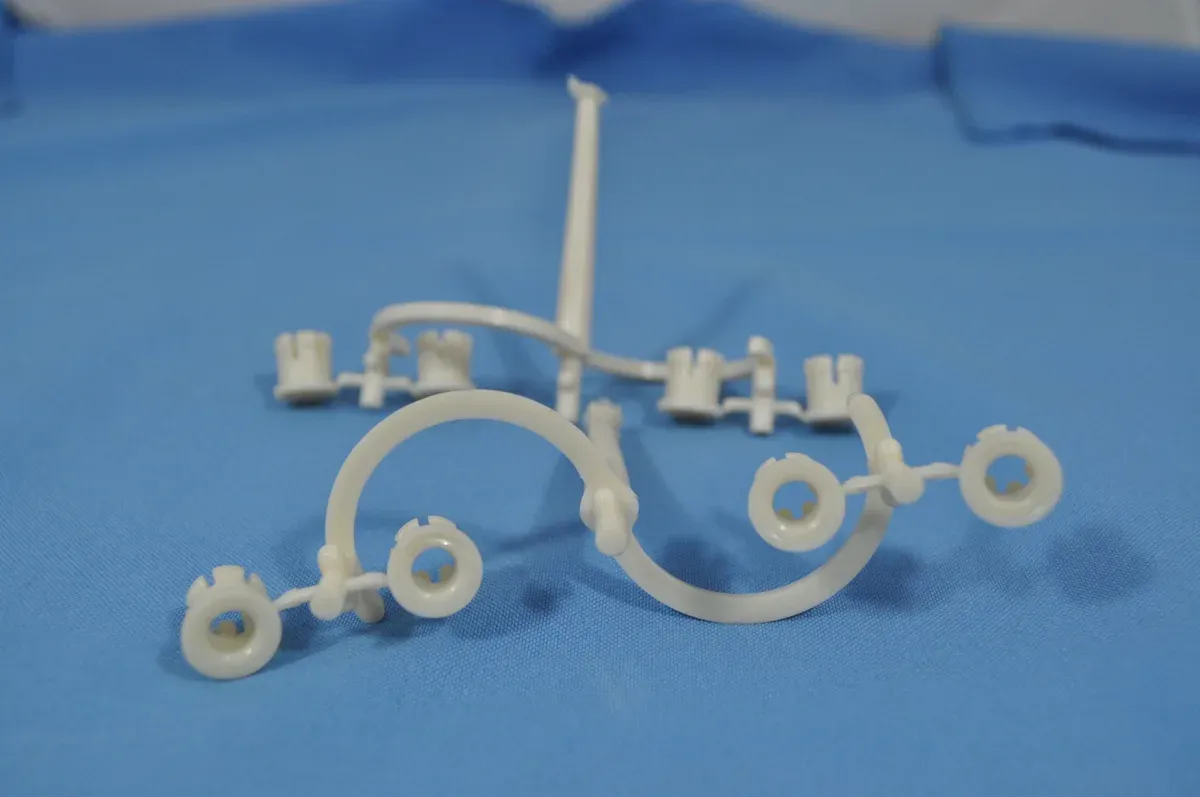
We both machine and injection-mold engineering plastics in the same Dongguan factory — machining on our CNC centers, molding on Haitian presses from 90T to 470T, including two-shot machines — so the advice here isn't tied to one process.
STEP, STP, IGES, STL, X_T and 2D PDF accepted. All files confidential; NDAs welcome.
MATERIALS
We'll tell you which route fits your quantity and your part.
Properties: Tough, rigid, easy to finish and paint; the general-purpose housing plastic. Typical parts: Enclosures, covers, consumer product housings, prototype shells.
Machining or molding: Both — machines cleanly for prototypes; one of the most-molded resins in the world for production.
Properties: Stiff, low-friction, dimensionally stable engineering plastic; the gear-and-bearing resin. Typical parts: Gears, bushings, rollers, snap-fits, precision mechanisms.
Machining or molding: Both — the first choice for machined moving parts; molds well for production volumes.
Properties: Very high impact strength, transparent grades available; the "unbreakable window" plastic. Typical parts: Guards, lenses, sight glasses, protective covers, strong housings.
Machining or molding: Both — machines well with care (it can stress-crack); molds into tough transparent and opaque parts.
Properties: Best optical clarity of the common plastics, polishes to a glass-like finish. Typical parts: Displays, light guides, covers, signage, cosmetic transparent parts.
Machining or molding: Mostly machining — ideal for low-volume optical parts; brittle, so design and handling matter.
Properties: Strong, wear-resistant and tough; absorbs moisture, which changes its dimensions slightly. Typical parts: Gears, wear pads, rollers, structural parts under load.
Machining or molding: Both — machined for precision dry parts; molded widely. Flag moisture exposure in the RFQ; glass-filled grades mold stiffer parts.
Properties: Light, chemically resistant, fatigue-proof — the living-hinge plastic; does not absorb water. Typical parts: Hinges, containers, chemical-exposed parts, automotive and appliance components.
Machining or molding: Mostly molding — soft and flexible, so machined PP parts need fixturing care; the default choice when a living hinge is designed in.
Properties: The high-performance option: keeps strength and stiffness at temperatures that soften most plastics, excellent chemical resistance. Typical parts: High-temperature mechanical parts, electrical insulators, demanding industrial and medical-adjacent components.
Machining or molding: Mostly machining — molds only at high volumes because resin and tooling costs are high; machine prototypes first, always.
Properties: Lowest friction of any solid plastic, outstanding chemical resistance, very soft and slippery. Typical parts: Seals, gaskets, liners, low-friction pads, chemical-handling parts.
Machining or molding: Machining only in practice — PTFE does not melt-flow, so it cannot be conventionally injection molded; parts are machined from stock shapes.
Properties: Extremely abrasion-resistant and slippery; the wear-strip and chute-liner plastic. Typical parts: Wear strips, guides, liners, rollers, food-industry components.
Machining or molding: Machining only in practice — like PTFE it does not injection-mold conventionally; machined from sheet and rod.
MATERIALS
Both processes start from the same drawing. Which one you want depends on quantity, geometry and what the part has to prove:
Machine it when quantities are small (from a single piece upward — our CNC MOQ is one piece), when the design is still changing, when tolerances are tight, or when the material cannot be molded (PTFE, UHMW). No tooling cost, either.
A machined part is also the fastest way to validate a design in the *actual* production material — far more meaningful than a 3D print in a look-alike resin.
Mold it once the design is frozen and quantities grow. The mold is a one-time investment; after that, unit cost drops far below machining and stays there. Our presses run 90T–470T, and a rigid body with a soft grip can be two-shot or overmolded on our 360T two-shot machines.
Do both, in sequence — the route most of our customers take. Machine the first articles and small batches. Confirm fit and function. Then cut the mold in the same factory, with the same engineering team.
The full reasoning, including how the break-even works, is in [→ CNC Machining vs Injection Molding: Which Is Right for Your Part?].
Material and process interact, too. A PA part that must hold tight dimensions in humid service may be better machined from conditioned stock than molded. POM gears at volume? They mold beautifully.
PEEK almost always starts machined — the resin costs enough that you want the design proven before you commit to tooling, or to a large machining run.
MATERIALS
Standard for functional parts; molded surface texture is set by the tool finish you specify.
A light matte texture that blends tool marks on machined parts.
Essential for PMMA and PC optical parts, and done carefully, because heat damages both.
ABS paints and bonds well, which is why it owns painted housings.
Ask in the RFQ if your part is one component of a larger product; molding, finishing and sub-assembly under one roof is common in our orders.
Plastics don't take every metal finish. Anodizing is a metal process. Plating on plastic exists, but it's a different, specialized route. If your drawing calls for a metal finish on a plastic part, the DFM review will flag it — and propose the version that actually works.
MATERIALS
Plastics hold looser tolerances than metals. Honest suppliers say so up front: under ISO 2768-mK we quote standard ±0.25 mm (±0.010 in) and precision ±0.05 mm (±0.002 in) for plastic parts.
Three physical reasons sit behind those numbers. Plastics expand with temperature more than metals do. Some — PA is the usual case — absorb moisture and change size slightly. And thin plastic parts flex under clamping and cutting forces.
Tight dimensions are still achievable on the features that matter, especially in stable materials like POM. The DFM review will tell you which callouts are realistic and which ones just cost you money. See [→ CNC Machining Tolerances Explained: Standard vs. Precision].
Custom Injection Molded Parts · Custom Plastic Injection Molds · CNC Machining · CNC Machining vs Injection Molding: Which Is Right for Your Part? · Aluminum Alloys for CNC Machining · Stainless Steel for CNC Machining
Upload the drawing, tell us the quantity you have in mind, and let the free DFM review settle both — material and process, with a quote within 24 hours. NDAs welcome.