Free-machining grade
Properties: A small sulfur addition makes it cut noticeably easier than 304 — the fastest stainless to machine. Typical parts: High-volume turned parts, shafts, fittings, fasteners and bushings for benign indoor environments.
MATERIALS
Stainless shows up when aluminum isn't strong, hard or corrosion-resistant enough — food and fluid handling, outdoor and marine hardware, medical-adjacent equipment, chemical environments. The three grades we machine — 303, 304 and 316 — look identical on the shelf.
On the invoice, and in service, they don't. You're trading machinability against corrosion resistance, and getting it wrong in either direction costs you. 316 spec'd "just in case" is one of the most common unnecessary costs we see in stainless RFQs.

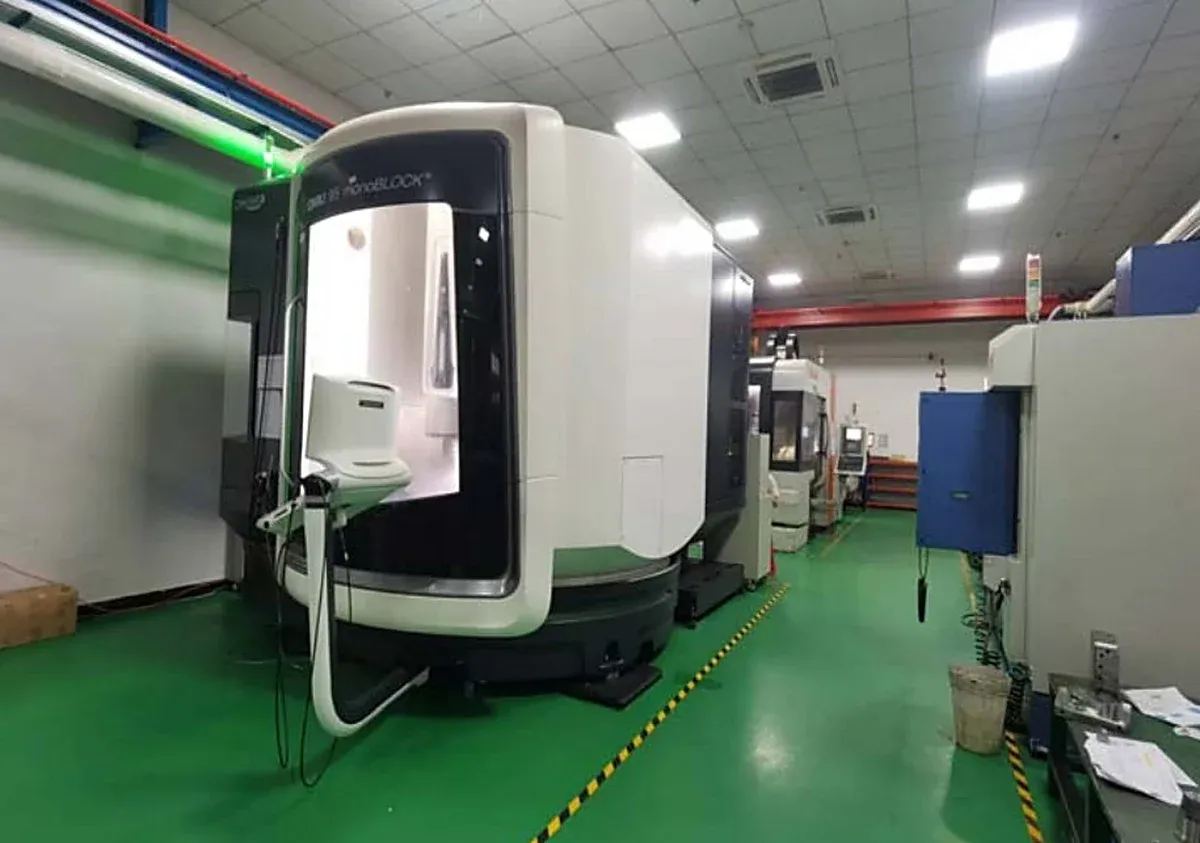
We turn, mill and mill-turn stainless in the same Dongguan factory where we machine aluminum, so a mixed-material assembly stays with one supplier. Here's how we help buyers pick between the three.
STEP, STP, IGES, STL, X_T and 2D PDF accepted. All files confidential; NDAs welcome.
Properties: A small sulfur addition makes it cut noticeably easier than 304 — the fastest stainless to machine. Typical parts: High-volume turned parts, shafts, fittings, fasteners and bushings for benign indoor environments.
Machining notes: Best machinability of the three; the trade-off is reduced corrosion resistance and poor weldability — do not specify it for welded or wet service.
Properties: Good corrosion resistance in most ordinary environments, weldable, the most widely used stainless grade in the world. Typical parts: Food-equipment parts, enclosures, brackets, consumer and industrial hardware.
Machining notes: Work-hardens as it is cut — feeds, speeds and tool condition matter; machines slower than 303 but is the safe default for most applications.
Properties: Contains molybdenum, which markedly improves resistance to chlorides — salt water, coastal air, many process chemicals. Typical parts: Marine fittings, chemical and pharmaceutical equipment parts, outdoor hardware in aggressive environments.
Machining notes: Machines similarly to 304 (slightly tougher on tools), but the material itself costs more; worth it only where the environment demands it.
Choose 303 when the part lives indoors and volume matters. Turned components in dry, benign conditions — instrument fittings, shafts, spacers, fasteners — are where 303 pays off. It cuts easily, and that shows up directly in unit cost, especially on repeat orders.
Two disqualifiers: welding (303 welds poorly) and wet or corrosive service.
Choose 304 as the default. Humidity, washdowns, food contact areas, general outdoor exposure, no specific chemical attack? That's 304. It welds properly, resists ordinary corrosion well, and stocks everywhere.
Choose 316 when chlorides or chemicals are actually present. Salt spray. Seawater. Pools. Coastal installations. Chemical processing, or medical and pharmaceutical settings where the cleaning agents bite — those justify 316's molybdenum and its price.
A part sitting in an office, a warehouse or a dry machine enclosure gains nothing from 316 except cost. If your drawing specs it anyway, we'll say so in the DFM review.
One more practical check: magnetism and passivation. All three grades are austenitic — essentially non-magnetic in the annealed state, though machining can induce a slight pull. And whichever grade you land on, specify passivation if corrosion performance matters.
Machining disturbs the protective surface layer; passivation restores it.

Standard for functional internal parts.
The important one: removes free iron from the surface and restores full corrosion resistance after machining; we recommend it for any stainless part in wet or outdoor service.
Visible parts, and surfaces that have to clean easily, such as food-contact hardware.
A uniform matte finish that blends machining marks away.
Directional satin, for visible enclosures and panels.
Available where a drawing calls for it, though stainless rarely needs plating for corrosion reasons.
It doesn't need black oxide or zinc plating to survive. Money spent on coatings it doesn't need is better spent on passivation — and, where relevant, on the right grade in the first place.
If your other parts are aluminum, two things will surprise you. First, the schedule: stainless cycle times run longer and tooling consumption runs higher, so the same geometry simply eats more machine hours. Build that into your plan instead of discovering it in the quote.
Second, weight. Stainless is roughly three times as dense as aluminum — that matters for handheld products, assemblies that ship by air, and anything that moves. Neither point argues against stainless. Both argue for choosing the grade (and the family) deliberately. That's the DFM conversation.
Same two levels as every metal we cut, under ISO 2768-mK: standard ±0.13 mm (±0.005 in), and precision ±0.025 mm (±0.001 in) on the features that need it. Once machined, stainless holds precision well.
Getting there is the cost: it cuts slower than aluminum, work-hardens if tools dwell, and wears tooling faster — which is why the same geometry costs more in stainless than in aluminum (see [→ What Does CNC Machining Cost?]).
Turning and mill-turn are in-house, inspection is on fully automatic CMMs, and CMM and dimensional reports are available. Maximum CNC travel 800 mm (31.5 in); MOQ one piece.
Stainless Steel CNC Turned & Milled Parts · CNC Machining · Aluminum Alloys for CNC Machining · CNC Machining Tolerances Explained: Standard vs. Precision · What Does CNC Machining Cost?
The free DFM review includes an honest grade recommendation — including when the cheaper grade is the right one — and your quote is back within 24 hours. NDAs welcome.